What Actually Works When Growth Stalls?
In this post, Ian suggests six steps to move from hacks and hustle to a go-to-market strategy.
Across early-stage startups and established B2B tech SMEs, we repeatedly see teams working hard, shipping content, running campaigns, and filling calendars, yet revenue growth remains stubbornly slow. Confidence dips. Investors get twitchy. And the instinctive response is to add more activity.
For early-stage founders, this often shows up when founder-led selling reaches its natural limits, and the pool of early adopters starts to dry up. For more established SMEs, growth tends to plateau as markets shift, competition increases, or execution loses its sharpness.
In our experience, these moments happen when focus drifts from the fundamentals.
Three reasons growth stalls
Broadly speaking, there are three reasons for momentum to stall:
- Poor market fit: Not just features and functionality, but pricing, category positioning, competitive context, and market size.
- Poor market awareness: Even when there is fit, buyers may not know you exist or understand why you’re relevant.
- Poor execution against the opportunity: The market is viable, and awareness exists, but sales velocity is inconsistent or has slowed.
None of this happens because of a lack of effort; in our experience, it’s usually a loss of focus on the fundamentals.
Random hacks and tactics don’t work (alone)
To address these challenges, it’s tempting to look for the easy button.
Scroll through LinkedIn, and you’ll find no shortage of growth hacks, shortcuts, and channel-specific advice. Often, the call comes from within the house, as well-meaning colleagues suggest the latest tactic to try.
However, while these ideas may deliver a tempting quick sugar rush of noise and activity they can distract the revenue team, waste time or annoy your skeptical potential buyer and erode trust.
From tactics to GTM
For any tactic to move the needle, new or old, trendy or traditional, it has to be a coherent part of a go-to-market plan or strategy.
We need to cut out distractions, noise, and activity that just spin the wheels, refocus on the category and buyer, and reset around some key fundamentals to understand where things are drifting.
A six-point plan
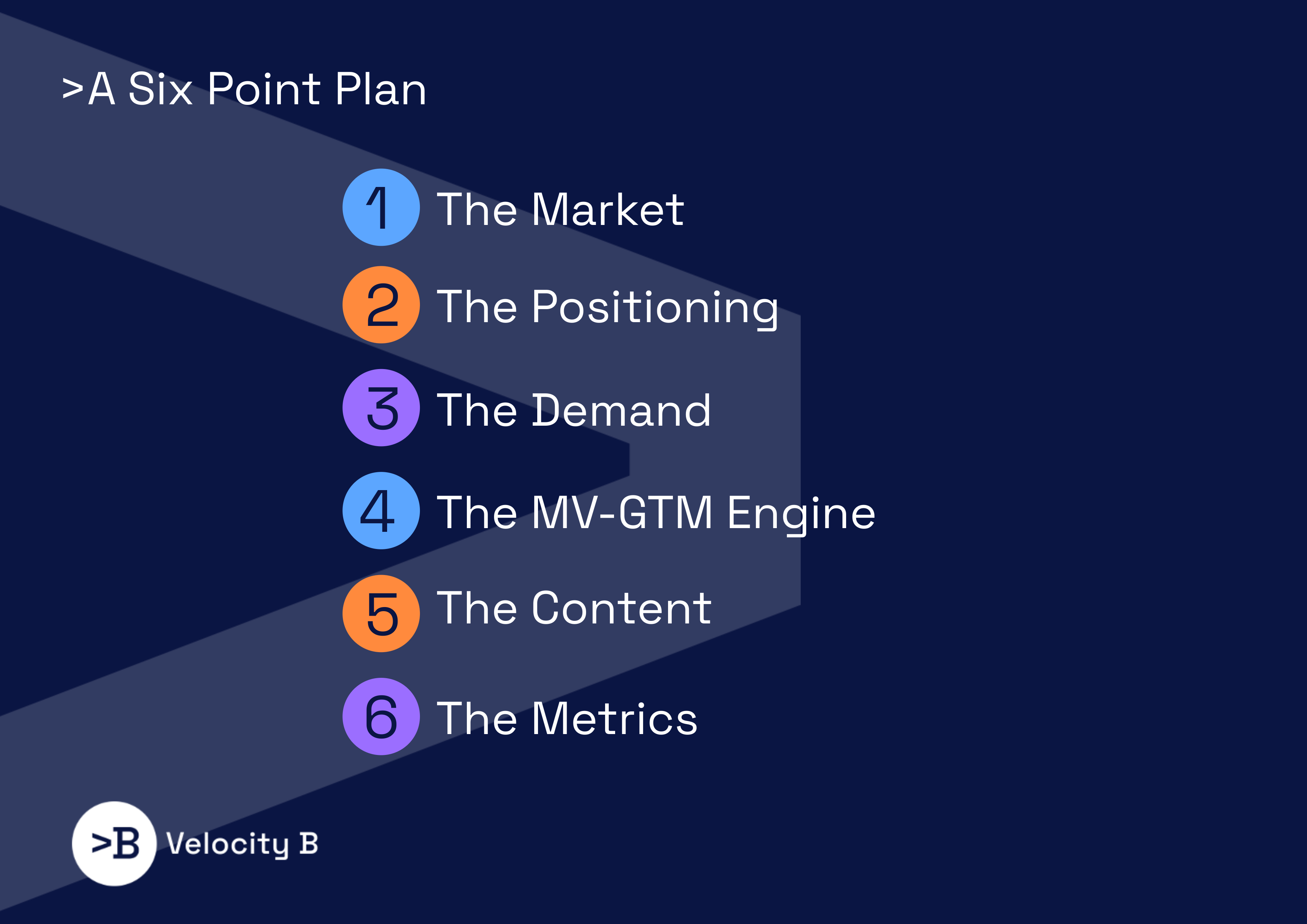
To address the reasons we see B2B tech companies stall, we’ve identified six areas to focus on to understand the market, sharpen execution, and measure what truly matters.
- The Market - Understand who you’re really for today, the size of that market, and the category landscape.
- The Positioning - Pick a buyer-recognisable lane instead of being “interesting but unclear”.
- The Demand - Understanding whether buyers care, know, and are ready to buy from you, and the slice of that market you can realistically address.
- The Minimum Viable GTM Engine - Replacing gut-feel driven random acts of sales and marketing with a simple, tight, repeatable commercial system.
- The Content - Building awareness and trust before the sales conversation begins.
- The Metrics - Measuring what drives decisions, not distracting vanity metrics that justify activities and look pretty on a dashboard.
Each of these requires a workstream, guided by a set of objectives and key results.
Your guide
To help founders and SME leaders sense-check these six areas, we pulled together a practical guide based on what we see working and not working across B2B tech businesses.
It’s not a collection of hacks or tactics. It’s a structured reset, designed to help you work out where things are drifting and where to focus first.
It’s written for B2B tech founders, SME leaders, and commercial teams who know there are no shortcuts and want clarity, momentum, and more predictable growth.
It’s not designed to be exhaustive. It’s intended to be useful for teams that want to regain focus; it’s a spark to get you started.
Download the guide
Ian Truscott
With a background in tech and product development, Ian is an experienced marketing leader, CMO, writer, and trusted advisor.
Follow Ian on LinkedIn →Stay up to date
Tips, new research, and ideas on creating velocity in sales and marketing — straight to your inbox.
Related posts
Acres of Diamonds: A Growth Lesson for Founders
In this article, Mark draws inspiration from a 19th-century essay to offer a growth lesson: Your opportunity for revenue might be closer to home than you think.
Sales Enablement - A Revenue System, not a Training Day
Alex goves 5 quick tips on creating a sales enablement function
Great Sellers Make Buying Easier
Prevent the dreaded "do nothing" by helping the buyer buy - Alex shares 5 helpful tips.
Want to go deeper?
If this topic struck a chord, let’s look at what it means for your business.
Let’s chat